
Dallas County Parole and Probation Differences
Probation is a court-ordered form of supervision. A Dallas County court may impose it after a jail release, through a suspended sentence, or as another case disposition. Probation does not prove that the person served time in a Missouri prison. Parole is different. The Missouri Parole Board may order parole after part of a prison sentence has been served. Conditional release is the supervised portion of an eligible prison term set by statute. The Missouri Department of Corrections Division of Probation and Parole supervises court probationers, people released by the Board, conditional-release clients, and interstate compact clients.
The distinction matters when reconstructing a Dallas County release. A probation record points back to the sentencing court and its judgment. A parole or conditional-release record points back to MODOC custody and a Board or statutory release process. Each can show that someone is in the community under conditions, but neither is the same as final discharge. The active MODOC Offender Web Search covers active probationers and parolees as well as incarcerated people. It does not show people who have completed all MODOC supervision.
| Supervision type | Who authorizes it | What it indicates |
|---|---|---|
| Probation | Sentencing court | The person is serving a court-ordered term in the community, sometimes without a state-prison term. |
| Parole | Missouri Parole Board | The person left prison before the judicial sentence ended and remains under field supervision. |
| Conditional release | Missouri law and Board process | An eligible sentence has moved from its prison portion to a supervised community portion. |
These terms are easy to mix up. Their record sources are not interchangeable.
- Discharge
- The official end of a sentence or supervision obligation, not merely release from a jail or prison building.
- Absconder
- A supervised person whose location is unknown after failing to keep required contact or reporting.
- Field supervision
- Probation, parole, or conditional release managed by a community-based MODOC office rather than an institution.
- Interstate compact
- A formal system for supervising an eligible client in a state other than the state that imposed supervision.
Verify Dallas County Post-Release Supervision
A name missing from the Dallas County Jail's current list does not answer whether supervision began. First identify which agency last held the person. County release after bond or a local court order may lead to probation. Transfer into MODOC can lead to prison custody, parole, or conditional release later. The active MODOC search is the key state channel because it includes people assigned to an institution and people assigned to field supervision. Compare names and identifiers with care before calling an office.
- Search the MODOC Offender Web Search by the person's name or DOC number. Use the DOC number when available because similar names can produce a poor match.
- Open the matching record and note whether the assigned place reflects a field office or an institution. An institution means the person may still be in state custody.
- Call the sheriff-published Dallas County Adult Probation and Parole contact at 417-345-4091. MODOC Central Office at 573-751-8488 can also identify the responsible office.
- Provide the full name, DOC number if known, conviction county, and a narrow request to confirm active supervision and the assigned office.
- For completed supervision, use the MODOC historical Sunshine data or request the state record. Discharged people drop from the live offender search.
The official family-and-friends guidance says an office may confirm public facts such as current offenses, judgment, conviction county, supervision term, conditions, supervising office, custody or bond status, and a parole or conditional-release date. It can also address a Board release decision. The result should still be matched to the correct person and cause number.
The official MODOC search screen shows why the active status and assignment must be read together.
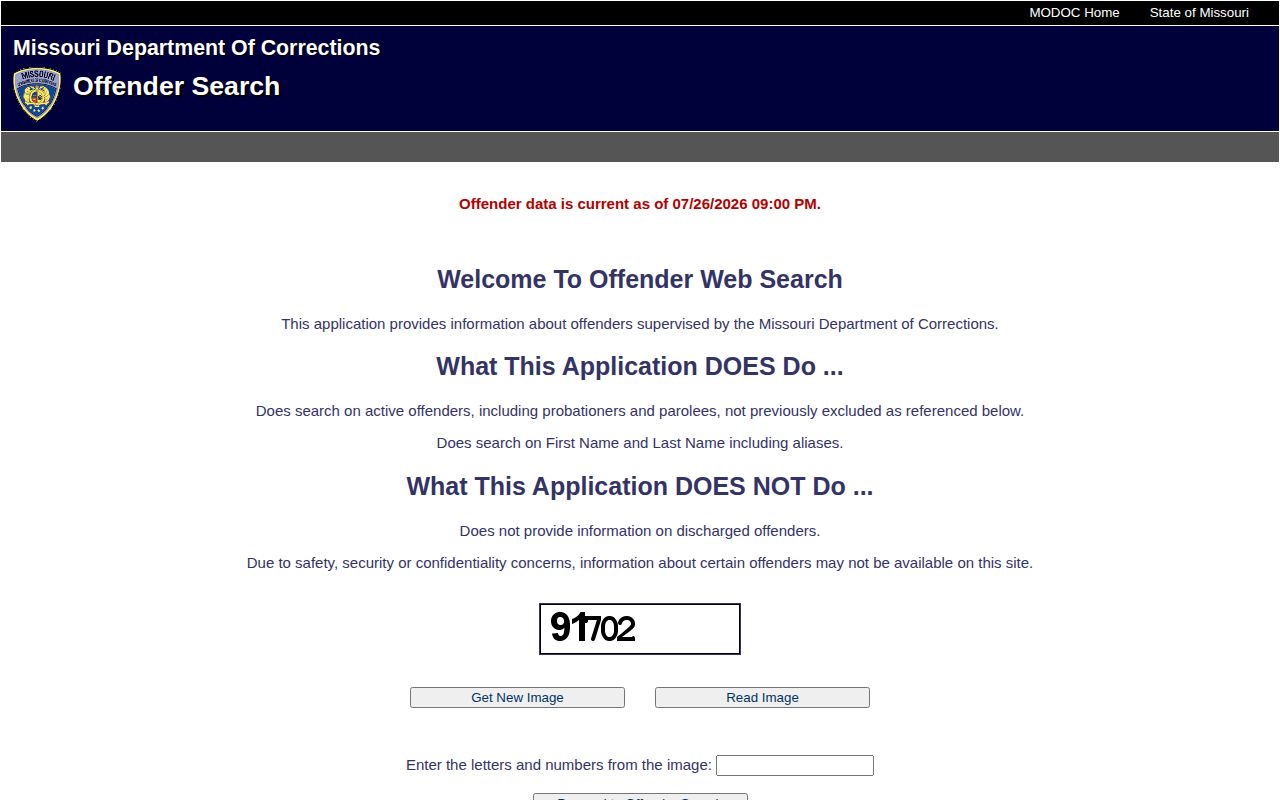
Its active-only scope also explains why a clean search cannot prove that no past Dallas County parole or probation term existed.
Note: The live jail roster serves current county custody, while the MODOC search serves active state custody and field supervision.
Dallas County Supervision Contacts
The Dallas County Sheriff's Office resource directory publishes a local Adult Probation and Parole phone number. That is the safest first contact for identifying the office that handles a Dallas County supervision record. MODOC's public office locator lists District 20S in Lebanon and District 20 in Camdenton, but the reviewed official sources did not conclusively assign Dallas County to either district. Geography alone is not enough. Call the local number or Central Office and ask staff to name the responsible reporting office.
Dallas County Adult Probation and Parole contact
Phone: 417-345-4091
Source: Dallas County Sheriff's Office resources
MODOC Central Office
Phone: 573-751-8488
General district hours: 8 a.m. to 5 p.m., Monday through Friday, except state holidays
Office finder: MODOC Probation and Parole locations
Ask whether the person is currently supervised, which office has the case, and which public fields can be confirmed. Do not assume the nearest listed office owns the record. If the issue concerns the underlying Dallas County judgment, use Missouri Case.net or the Circuit Clerk because P&P supervision does not replace the court docket.
Dallas County Absconder and Warrant Status
An absconder has not merely finished supervision. The term means the supervising authority does not know the person's location after required contact or reporting failed. A violation report, warrant, or Board action may follow through the proper process. Missouri Section 217.703 also stops earned compliance credits for months affected by an absconder report and while the person remains an absconder. Those credits apply to eligible community supervision, not to time served inside the Dallas County Jail or a state prison.
The Dallas County sheriff has posted a news item labeled “P&P Absconder.” That item shows local deputies may coordinate with probation and parole officers. It is not a full absconder list, a warrant database, or a complete history of Dallas County enforcement. Verify a named person's status with the supervising office and the court record. A VINE status may help track a custody change at a participating agency, but it does not establish whether a supervision warrant remains open.
Important: Do not treat a missing MODOC result as discharge. The person may have discharged, moved systems, been entered under different identifying data, or require a historical record check.
Dallas County Parole Hearing Decisions
The Missouri Parole Board alone orders parole. A hearing is an eligibility review, not a release event. The Board considers the governing sentence, institutional conduct, adjustment, programs, and risk information. Its published time-to-serve guidelines do not guarantee release, and Section 217.690 does not create a right to parole or shorten the court's sentence. A decision may grant release on a future date, deny release and set another hearing, defer the matter for more information, or later be rescinded under applicable authority.
Written decisions normally take about eight to twelve weeks, according to the official hearing-process material. Another hearing may be placed one to five years later. No official public statewide search for individual hearing calendars or decisions was located. For a specific Dallas County case, contact the Board at 573-751-8488 or the institutional parole office. Eligible victims may also use the Office of Victim Services and MOVANS notification process.
The MODOC parole hearing process distinguishes the review from a final release date.
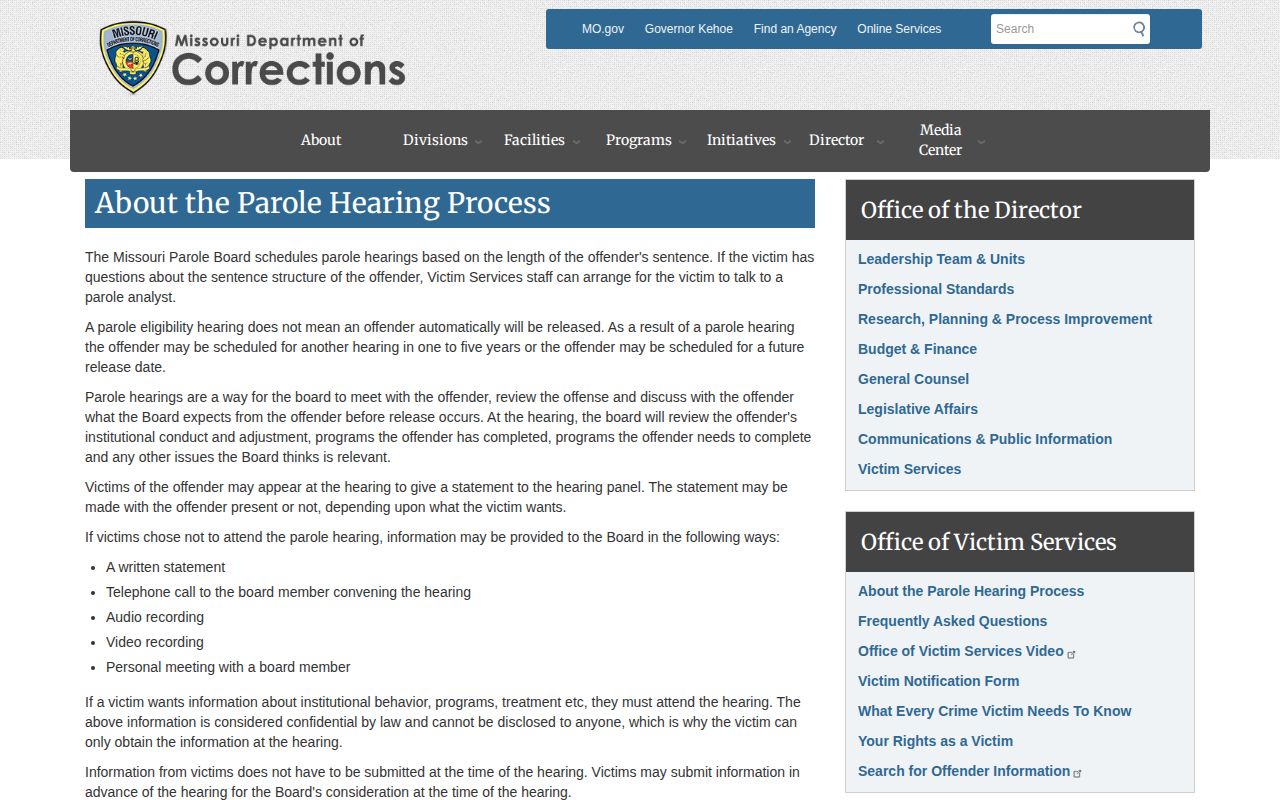
That distinction prevents an expected Board date from being reported as an actual Dallas County release or active parole start.
Ending Dallas County Post-Release Supervision
Release from a facility and discharge from supervision occur at different points. Someone can live in Dallas County while still serving probation, parole, or conditional release. Eligible clients may receive thirty days of earned compliance credit for a full compliant calendar month under Section 217.703. Credits can stop due to a violation report, custody, a revocation or suspension motion, or absconding. The statutory calculation also accounts for restitution and minimum completed-supervision rules.
Do not calculate an individual's discharge from the statute alone. Confirm it with P&P or obtain historical MODOC data. That file contains DOC ID, cause number, conviction county, supervision dates, and sentence-completed fields that can distinguish one Dallas County sentence from another. A completed value for one sentence does not prove that every cause or supervision term ended. The broader Dallas County released-inmate search and record path explains how county, court, and state records fit together when the custody history spans more than one system.
Dallas County Post-Release Reentry Resources
Dallas County has an unusually useful local resource layer on the sheriff's compact website. The directory lists the Circuit Clerk, prosecutor, Adult Probation and Parole contact, victim contacts, health services, crisis support, transportation help, and recovery meetings. It is a navigation source, not proof that someone has been released or is under supervision. Each listed group controls its own times, intake rules, and eligibility.
Named Buffalo resources include Chapter 2/Serenity Club meetings and A Design for Living meetings. Grace Community Church is listed for showers, laundry use, and household items. Family of God Church is listed as a contact for rides tied to grocery-store and medical visits. A person leaving custody or beginning Dallas County probation can call ahead to see which service is currently offered. No listing should be read as a guaranteed corrections program or a term of supervision.
The Dallas County Sheriff's Office resource directory also places the local P&P number beside other court and county contacts. That local organization makes it useful for both supervision verification and practical planning after release.
Note: Resource availability can change, so confirm hours, eligibility, and transportation directly before relying on a listed Dallas County program.