
Dallas County VINE Release Coverage
VINE is a custody-status and notification service. Missouri's public route is Missouri VINELink. The Dallas County Sheriff's Office also links VINELink in its navigation as “State-wide inmate info,” so it is a real local referral for a person connected with the Dallas County Jail. The official sources reviewed did not provide an accessible participation list that confirms the county's exact feed, event types, update cycle, or how long an old result remains searchable. A user should therefore check the service, identify the reporting agency, and avoid treating the mere presence of the local link as a promise that every Dallas County booking will appear.
VINELink and the sheriff's current-inmate page answer different questions. The sheriff page is a manually maintained view of people shown in current Dallas County custody. VINELink can display status from a participating agency and can offer notification controls. Neither source is the county's historical booking-and-release record. If a name vanishes, the event might be community release, transfer, correction of a record, or an agency update. The Dallas County Sheriff's Office must confirm when the local custody episode ended and whether another authority received the person.
Key distinction: A Dallas County release status ends one agency's custody. It does not always mean the person entered the community.
Search Dallas County VINE Records
Begin with enough identity detail to separate people who have similar names. VINELink fields vary with the participating agency, so do not assume every record will include a photo, release date, or identifier. Dallas County's public jail list does not show a date of birth or unique booking number. A case number from Missouri Case.net or a known custody date can help when direct confirmation is needed, but the VINE search itself should use only the criteria the current screen offers.
- Open the official Missouri VINELink route and choose the custody or offender search offered for Missouri.
- Enter the person's name. Add an identifier only when the screen provides that option and the identifier is known.
- Review every close match. Compare the reporting agency, age or other identity fields, and the custody context shown.
- Open the best match and read status and agency together. Do not isolate a word such as “released” from the agency that reported it.
- If the record suggests release or no current custody, call the Dallas County Sheriff or the responsible state agency to verify the event.
- If no match appears, retry reasonable name forms and then use the county, state, court, or federal route that fits the person's custody history.
The broader Dallas County released inmate search explains how the sheriff record, Case.net, Missouri Department of Corrections data, and federal sources fit together. VINELink is most useful when the goal is to check one known person or register for a later alert. It is not a substitute for that full system-by-system search.
If the person appears on the Dallas County current list, the public page indicates that the person is displayed as being in local custody, but it does not predict a release. If the name is absent from both that list and VINELink, call the sheriff with the full name, approximate booking date, and case number when known. Ask whether the Dallas County custody event ended, the departure time, and whether the person went to the community or to another agency. This narrow request addresses the point that VINE cannot settle by itself.
Missouri's official search landing screen shows the starting point for this process. View the live source at Missouri VINELink before relying on interface details.
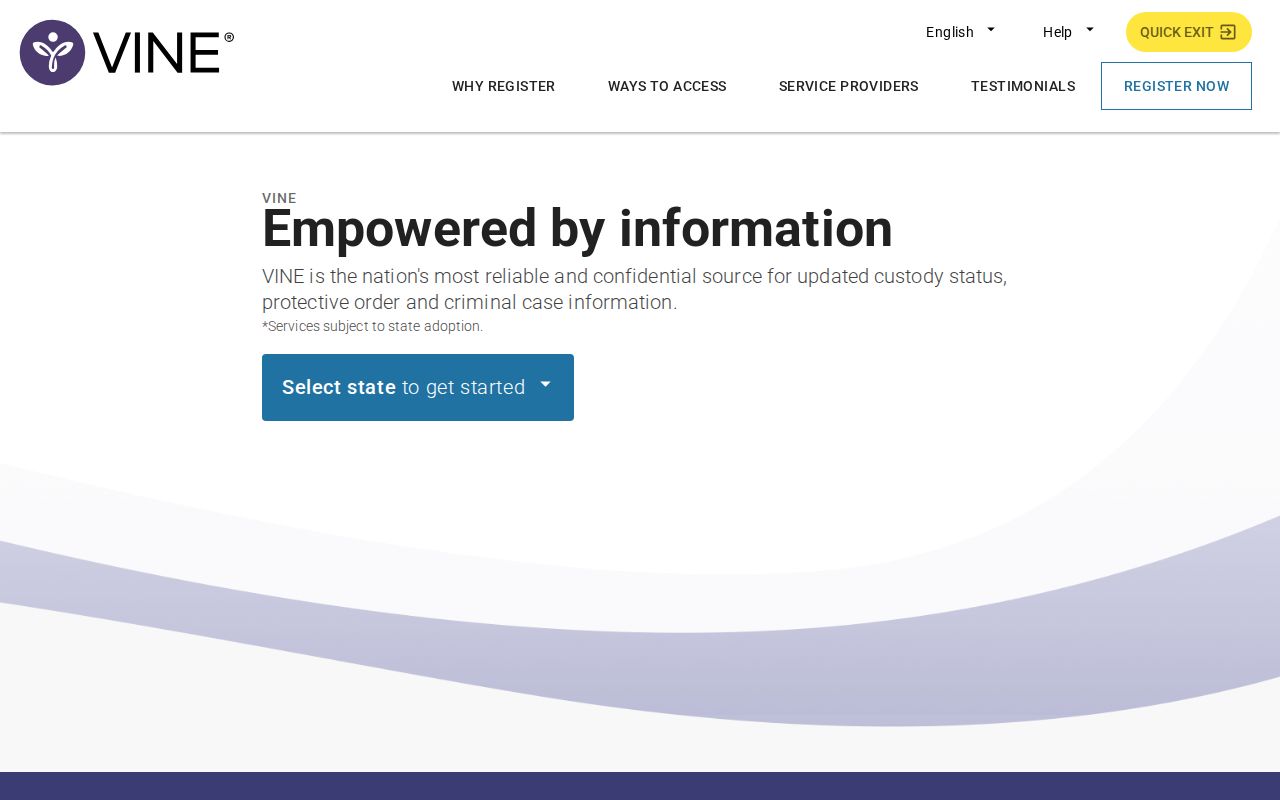
The screen can change, so follow its current labels while preserving the same identity, agency, and status checks.
Note: A spelling mismatch or absent result does not prove that a Dallas County release occurred.
Dallas County VINE Release Fields
A matching VINE record commonly centers on identity, the reporting agency, custody status, and notification choices. Location may appear when the participating feed supplies it. Exact fields depend on that feed. Research did not verify a stable Dallas County released-result layout, so the table describes how to read a field when it appears rather than promising that each field will always be present.
| Field | What it can show | How to use it |
|---|---|---|
| Name and identity details | The person tied to the record | Compare all available details before opening alerts |
| Reporting agency | The jail or corrections source supplying status | Identify whose custody changed and who can confirm it |
| Custody status | The current state reported by that agency | Read it with the agency and update context |
| Location | A facility or custody location when supplied | Use it to distinguish Dallas County from another system |
| Identifier | An agency-specific offender or record number | Use it to reduce same-name errors |
| Notification control | Available phone, email, text, or account options | Register only from the matching record |
A release date or photo may appear for some agencies, but Dallas County coverage for those fields was not confirmed. Likewise, “no longer in custody” under one agency does not disclose a court disposition or final discharge from supervision. A county transfer can close a jail entry while MODOC, another county, or a federal authority continues custody. The agency field is what keeps a status from being read too broadly.
Register Dallas County Release Alerts
Notification registration starts from the verified person's record, not from a general search result list. Available channels may include phone, email, or text, depending on the current interface and reporting agency. The alert is meant to report a custody event supplied to VINE. It is not a certified Dallas County release record, and it cannot show that all other holds or cases have ended.
- Select “Get Notified” or the current equivalent on the matching record.
- Choose one of the contact channels shown for that record, such as phone, email, or text.
- Enter the contact destination carefully and complete the on-screen verification or account step.
- Save any confirmation information and review the event types offered before finishing registration.
- For a MOVANS telephone registration that supplies a personal identification number, retain that PIN. Missouri's official FAQ says calls repeat until the selected PIN is entered.
- When an alert arrives, verify the person, reporting agency, and event directly with the responsible office.
MOVANS means Missouri Victim Automated Notification System. Its telephone process can differ from the current VINELink web workflow. The web service may use account or contact verification instead of a PIN. Follow what the screen shows; do not expect a PIN unless the registration process provides one. Contact data should also be kept current because an old number or blocked email can defeat the purpose of an alert.
Note: A VINE alert reports agency data and should be checked against the agency's own custody record.
Dallas County Statewide VINE Referral
The Dallas County Sheriff's Office gives VINELink unusual local weight by listing it directly as statewide inmate information. That placement supports checking Missouri VINE after a person no longer appears on the sheriff's current list. It does not establish a county-specific archive. No accessible official coverage document confirmed Dallas County's precise participation, event set, or retention rules. The careful sequence is to search, compare the reporting agency, and call the sheriff when the result concerns a Dallas County Jail event.
For eligible victims and family members in a state corrections case, the MODOC Office of Victim Services provides a separate notification path. That office can address parole hearings, hearing results, release to the community, escape, or death after registration. Its public contact is 573-526-6516, and the listed email is victims@doc.mo.gov. This state route is not a general historical roster. It also does not replace the booking-and-release record held by Dallas County.
The distinction matters when one Dallas County case moves through several systems. A person may leave the local jail for MODOC, later enter parole or conditional release, and eventually receive final discharge. A county VINE result, a state victim-services notice, and a historical MODOC record can each document a different stage. Match the notice to the event being verified.
Confirm Dallas County VINE Releases
VINELink does not cover every custody system. The Federal Bureau of Prisons maintains its own inmate locator, and federal results must be checked there. Missouri Case.net shows court authority and docket events, but it is not a gate log. The live MODOC Offender Web Search covers active offenders, including some people on probation, parole, or conditional release, yet it expressly excludes finally discharged offenders. A person can therefore be absent from one source and still have a record in another.
For a Dallas County Jail event, call 417-345-2441 and ask whether the named custody episode ended, when it ended, and whether the departure was community release or transfer. When written proof is needed, request the booking-and-release entry, custody history, or equivalent record. Ask for the departure time, release reason or code, receiving agency, and the legend for any codes. That record is stronger than a VINE screen because it can distinguish a bond release from a transfer or other departure.
Limits: VINE data can lag, Dallas County feed details are not guaranteed, federal custody is outside VINELink, and a missing result never proves release.
If a state sentence is possible, use the MODOC active offender search. An active field assignment can indicate supervision rather than prison. For final discharge, consult MODOC's nightly Sunshine historical data or request the relevant record. These routes preserve the difference between leaving Dallas County Jail, leaving state prison under supervision, and completing all MODOC custody and supervision.
The MODOC live search is limited to active offenders. A person on probation, parole, or conditional release may still appear because field supervision remains active. A finally discharged person will not. For the latter, the department's Sunshine page offers nightly historical offender data with sentence and completion-related fields. Those records can help trace a state history, but their minimum and maximum sentence dates are not the exact time a person walked out of Dallas County Jail. The agency that controlled each stage remains the source for that stage's event.